

House Inspection Haarlem
Most expats who come to us in Haarlem are buying their first Dutch house: a family home in a 1930s street, a narrow row house near the Spaarne, or an old townhouse with a cellar. With a house, the roof, the walls, the floor joists and the ground under it are all yours. So have it inspected before you commit.
Premiumkeur Haarlem is an independent building surveyor with an office at Tempeliersstraat 63 in Haarlem. Fred Tokkie was a contractor from 1983 to 2009 and has inspected houses since 2009. We have 4.9 stars from 704 Google reviews and 104 Trustpilot reviews. Check them on Trustpilot or read our reviews from English-speaking buyers.
☎ Phone 023-2340040 or WhatsApp +31 6 2956 3190. The inspection costs € 499 including VAT for a house up to 800 m³, plus € 0.50 for each m³ above that. We spend 1 to 1.5 hours in the house and you get the report within 2 working days.
Our general English page is Building Inspection Haarlem, and Americans who know the term from home can also read Home Inspection Haarlem. If you read Dutch, go to Bouwkundige keuring Haarlem (in Dutch).
You pay for every part of a house
In an apartment the owners’ association splits the big jobs. In a house nobody does. A new roof, repointing the front wall or replacing rotten joists comes out of your own pocket.
So we price every item: needed now, can wait five years, or just a wish.
A morning in the house with the inspector
You’re welcome to walk along, and we’d recommend it. The inspector explains in English what he’s looking at, so you see the soft spot in a window sill yourself instead of reading about it later.
Ask anything: where the main water valve is, what that stain on the ceiling means. Those answers often help more after the move than the report.
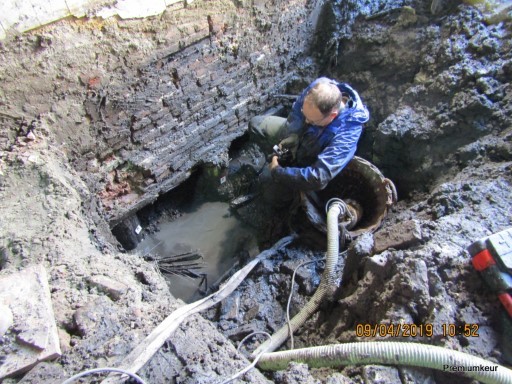
In the photos below, from left to right: 1. roof light inspected for leaks at the frame and the flashing; 2. building inspection on a national monument (rijksmonument); 3. foundation investigation on a terraced house in the Rozenprieel in Haarlem; 4. signs of woodworm found in timber during an inspection.



What we bring along
A flashlight and a ladder only get you so far. Our inspectors carry an infrared camera for cold spots and hidden leaks, a moisture meter, leveling instruments for floors and sills, an endoscope camera and a small crawl space robot.
There’s also a screwdriver and a couple of small pry bars in the bag. Plenty of Haarlem crawl space hatches are screwed down or stuck with old paint, and we’d rather open one carefully than skip it.
Houses built between 1880 and 1935
A large share of Haarlem’s houses date from roughly 1880 to 1935. They stand on timber piles or on a shallow brick footing (in Dutch: op staal), with timber ground floors and roofs that have been patched more than once. After a century the weak spots are nearly always the joist ends, the lead, the gutters and the foot of the walls.
Below are two videos in Dutch. “Why choose Premiumkeur” explains how we work for buyers, and “Building inspection Haarlem” follows an inspection in a Haarlem house (both in Dutch).


Who you ask to inspect is up to you
Because the Dutch system is new to you, it’s natural to go along with your agent’s suggestions. Keep in mind, though, that the agent is paid when the sale goes through. An inspector who gets a steady flow of work from agents has an interest in that relationship. That structural conflict of interest applies to your own buying agent too.
So pick the inspector yourself, even when the agent or mortgage adviser mentions a ‘partner’. You can always bring your own. Ask any inspector: Do you get work or fees from real estate agents or mortgage advisers? Will you go into the crawl space and onto the roof if it’s safe? Will you look at the foundation? Will you put your independence in writing? And read the terms for ‘global inspection’ and other limits.
Premiumkeur doesn’t work with real estate agents or mortgage advisers, pays and receives no referral fees, doesn’t recommend repair companies and doesn’t inspect for sellers.
Damp is the Haarlem problem
If one thing comes back in almost every Haarlem report, it’s moisture. Wet crawl spaces, rising damp at the foot of the walls, leaky cellars and high groundwater all play a part.
We measure walls and timber and look for the source, because a leak, condensation and rising damp each need a different fix. For more time on it there’s a separate damp inspection in Haarlem (in Dutch).
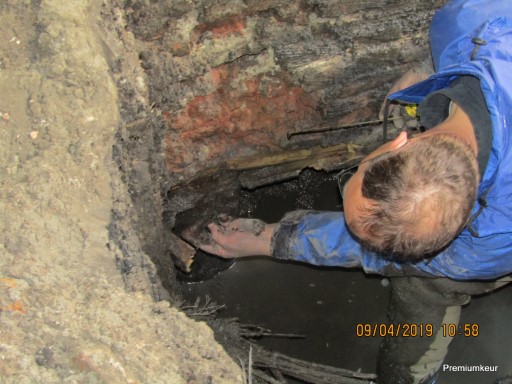
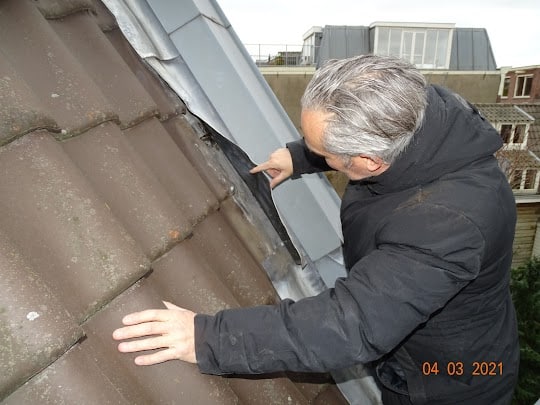
In the photos below, from left to right: 1. inspecting the longitudinal timber beams on top of the piles of an old foundation; 2. roof tiles checked up close on a pitched roof for cracks, slipped tiles and moss; 3. inspection of a pitched roof, checking the tiles, ridge and roof timbers; 4. foundation investigation at a listed building, measuring the facade for settlement.


Old cellars under the front room
Many older Haarlem houses have a cellar, sometimes only a few steps down. Many take on water when the groundwater rises. Patching and coating helps for a while. A fully dry cellar can mean a new concrete one, at a very different price.
The crawl space: where the joists rest
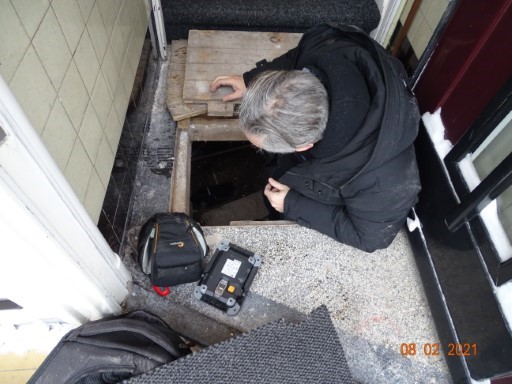
Under most houses with a timber ground floor there’s a crawl space, the kruipruimte. Joists, drains and damp all meet there. Our inspectors usually go all the way in. For a closer check with the robot camera, see our crawl space inspection (in Dutch).
The two videos below are in Dutch. “Foundation investigation Haarlem” shows how we measure a house for foundation risk, and “Crawl space inspection Haarlem” takes you under a timber floor (both in Dutch).

Video: Funderingsonderzoek Haarlem

Up on the roof
Where it’s safe we climb onto the roof, sometimes with a harness. From the street you can’t see a cracked tile, loose lead around the chimney or moss blocking a gutter. The tiles on an old house often last; the flashings and gutters give up much sooner.
Dormers and flat roofs at the back
Lots of houses got a dormer and a flat-roofed extension in the yard. Those are where we find leaks most often: at the sides of the dormer, where the flat roof meets the wall, and at drains full of leaves. A bitumen roof that feels soft or has blisters is near the end.
Next come two videos in Dutch: “How to avoid hidden roof defects during a building inspection” and “How to trace leaks at a dormer” (both in Dutch).


A realistic picture of the house
Recently we purchased a house in Amsterdam and we assigned Fred to do our technical inspection. I cannot recommend enough his service – he was extremely attentive, did a thorough inspection, had a critical eye and noticed every aspect of the house that require work or could result in future investments.
Review on Google, 5 stars
On the roof and on the bathroom floor
Fred is a top notch inspector in Amsterdam His services were definitely worth the cost. While inspecting our new home (pre offer) he was extremely detailed. He climbed the roof to check the tiles and even laid on the bathroom floors to check the level of the tiling and plumbing. With his construction background and thorough approach, Fred caught all the snags.
Review on Google, 5 stars
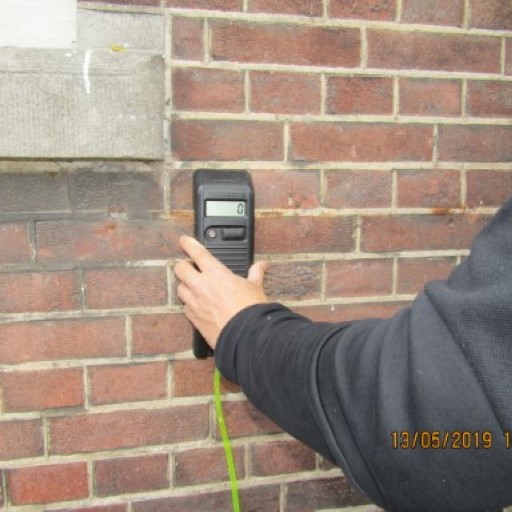
In the photos below, from left to right: 1. inspection of a listed building in the centre of Haarlem; 2. water found in a crawl space, traced back to a leaking pipe; 3. measuring a horizontal mortar joint along the front facade to see if the house has settled unevenly; 4. bitumen roof covering inspected for cracks, blisters and worn seams.



The boiler and the heating
Nearly every Dutch house has a gas boiler (cv-ketel) for heating and hot water. We read the year off the label, look for a service sticker, check the flue and see if there’s a carbon monoxide detector. An unserviced boiler goes in the report with the cost of a service now and a new one later.
Fuse box, earthing and solar panels
We open the fuse box (meterkast) and count the circuits and residual current devices. In older houses we regularly find open wiring or a bathroom without proper earthing. It’s no full electrical test, but it tells you if an electrician should come first. With solar panels we check how they’re fixed and whether the roof under them will last as long as they do.
Two videos in Dutch follow: “Premiumkeur Haarlem”, a short introduction to our Haarlem team, and “All about installing solar panels” (both in Dutch).


Window frames, paint and wood rot
Timber window frames suit an old house and need regular paint. When that slips, water gets into the joints and the bottom rails rot. We press the sills, check the putty and look for condensation between the panes.
Stairs, railings and steep Dutch staircases
Dutch stairs are steep, and in older houses steeper still. We check that handrails are there and fixed, and that balustrades on landings and balconies are solid. A missing handrail to the top floor is a common find.
In the photos below, from left to right: 1. timber window frames checked for wood rot, paintwork and loose glazing beads; 2. taking a moisture reading on a wall with a moisture meter; 3. zinc work on a dormer checked for corrosion and open soldered joints; 4. inspector checking the zinc and the joints of a dormer on a pitched roof.


Rotten beams found before the purchase
We are very satisfied with the very extensive and thorough building inspection of our future home. Fred Tokkie was willing to assess the crawl space as well, and it turned out that some beams under the house were rotten. It’s good that we knew this before we bought the house, instead of a surprise afterwards. In short, an excellent building inspection!
Review on Google (translated from Dutch), 5 stars
Every square meter of the roof
Recently had a building inspection done of our new house in Haarlem and we were very pleased. He even climbed onto the roof in an ingenious way, so that every square meter has now been seen and inspected. Fred is very committed and enthusiastic, explains without fuss and also makes the weaker sides of the house clear.
Review on Google (translated from Dutch), 5 stars
In the photos below, from left to right: 1. roof inspection on a listed canal house, checking slates, lead and timber; 2. fuse box checked for the number of circuits and residual current devices; 3. timber floor joists checked in the crawl space for damp, rot and woodworm; 4. dormer window inspected during a building inspection, including the cheeks and the roof on top.


Foundation: what a normal inspection can say
We look for the signs above ground: sloping floors, sticking doors, cracks. A seller may show you a funderingslabel (a foundation label based on area data) or readings from meetbouten, the measuring bolts the city fixed in some facades. Both are hints, not a verdict on your house.
For more certainty, add the foundation quick scan (phase 0) to the same visit, from € 898 in total. See the foundation risk check, phase 0 (in Dutch).
When phase 1 or phase 2 makes sense
If the quick scan raises questions, the next step is a foundation investigation phase 1, at € 699 to € 1,499 depending on the house. Phase 2, with digging next to the wall, starts at € 3,000. Any foundation check is a snapshot of the day we measure and comes without a guarantee. More on foundation investigation (in Dutch).
In the photos below, from left to right: 1. roof boarding inspected from the loft for damp stains and old leaks; 2. lead flashings checked during a building inspection, a common source of roof leaks; 3. sewer pipes inspected for leaks and the right fall; 4. chimney inspection on a Haarlem house, checking the stack and the flashing.


Cracks in the brickwork
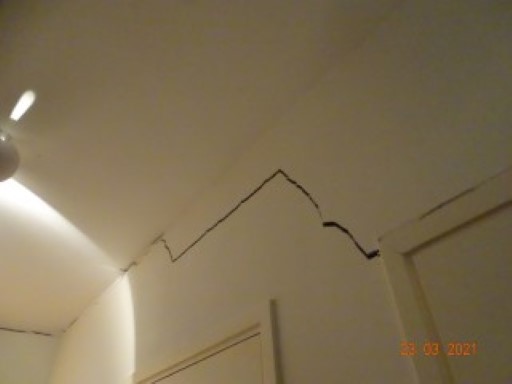
Most cracks in a Haarlem house are harmless: shrinkage, a rusting steel lintel, a frame fitted too tight. Some point to movement in the foundation, and the pattern tells you which. A stepped crack running from a window corner and widening at the top means something else than a hairline crack in the plaster. We measure them and say if we think they’re still moving.
Gutters and downpipes
A gutter that overflows soaks the same strip of wall every time it rains. Old zinc wears thin, and a box gutter between two houses is a known weak spot.
Below are two videos in Dutch: “Tracing roof leaks in Haarlem” and “How to inspect a roof during a building inspection” (both in Dutch).


Ventilation and condensation
Old houses were drafty, and that kept them dry. Add double glazing and seal the gaps, and the steam from showers and cooking stays inside. We check the extraction fans, the vents in the frames and the air bricks for the crawl space.
Insulation added later
Many older houses have had insulation put in afterwards: in the cavity, under the floor, sometimes on the roof. It lowers your energy bill, but done badly it can trap damp, for example when a crawl space is filled up with insulation granules. We note what we see and where it might cause trouble.
In the photos below, from left to right: 1. tracing a leak in a cellar, a common problem in older Haarlem houses; 2. slate roof inspected for broken and slipped slates; 3. crack investigation on a house in Haarlem, recording the width and direction of the crack; 4. inspecting a bell gable on an old facade.



Costs that land on the owner
You plan for the outside yourself: paintwork, flashings, gutters and repointing now and then. There’s no common fund. Our report lists what we expect within about five years.
Your report and the cost table
The report, the bouwkundig rapport, is in Dutch and arrives within 2 working days. Every item is scored for condition (NEN 2767 and NTA 8060), with a photo and a cost estimate. A cost table up front splits it into now, later and improvements. An English translation is € 100 extra. More on the cost of a building inspection (in Dutch).
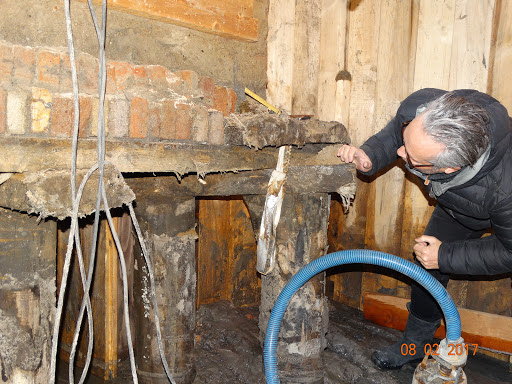
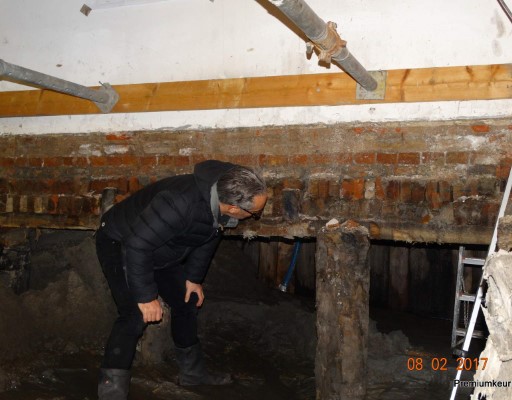
In the photos below, from left to right: 1. old kwaaitaal concrete floor slabs checked from the crawl space for rust and cracking; 2. inspector checking a flat roof covering for blisters, seams and standing water; 3. foundation investigation on a house in the Leidsebuurt in Haarlem; 4. crawl space inspection in Haarlem, where damp crawl spaces are common.


Talking to the seller with real numbers
A few small items rarely move a price. One big item can: rotten joists, a roof at the end of its life, a foundation that needs watching. With our estimate your agent can ask for a lower price or for the work to be done before the transfer.
The old age clause in your contract
For older houses, Dutch purchase contracts often include an ouderdomsclausule, an old age clause. It says you know the house is old and can’t expect modern standards. In practice it makes claiming from the seller later harder for defects linked to age, which is one more reason to find them before you sign.
Two videos in Dutch come next: “Crack investigation” and “Crack investigation in Haarlem”, about telling harmless cracks from structural ones (in Dutch).

Video: Scheuren onderzoek

Video: Scheuren onderzoek Haarlem
Quick to answer, good advice
Fast and professional response. Fred is very experienced and was able to give us some really good advice.
Review on Google, 5 stars
A craftsman with pride in his work
Fred is a craftsman with professional pride. If only there were more people like Fred in the construction and maintenance world. He knows his field and works thoroughly. You can build on his advice.
Review on Google (translated from Dutch), 5 stars
In the photos below, from left to right: 1. probing timber for wood rot during a building inspection; 2. beam ends checked where they rest in the wall, where damp brickwork causes rot; 3. inspecting the roof of a rear extension, a common place for leaks; 4. fred Tokkie inspecting a timber pile foundation.


Bring your list of questions
Write down what you noticed at the viewing: that damp corner, the crack above the back door, the floor that bounced. Send it to us or hand it to the inspector, and we’ll give you our view on each point on the spot. Can’t be there? We’ll call you afterwards.
Planning a renovation after you move in
Want to take out a wall, add a dormer or move the kitchen? Tell us beforehand, so we look harder at what that plan depends on: joists, roof structure, drains. If the neighbors are about to build, a nulmeting (in Dutch), a zero measurement that records the state of your house before their work starts, can save a dispute later.
The two videos below are in Dutch: “Foundation repair in Haarlem” and a second “Building inspection Haarlem” film about a different house (both in Dutch).

Video: Funderingsherstel in Haarlem

Video: Bouwkundige keuring Haarlem
Party walls and the house next door
In a row you share a party wall, usually the foundation and often a gutter with the neighbors. If next door leaks into your wall, or the whole row needs foundation repair, you can’t solve it alone.
Newer houses get checked too
A house from the 1970s or 1980s usually has a concrete ground floor and a cavity wall, so the weak spots are different. Electrics from that era are often behind today’s safety standards, and bathrooms from those years can leak behind the tiles.
In the photos below, from left to right: 1. inspector inside the crawl space checking joists, pipes and the damp level; 2. using an endoscope camera to look behind a wall or floor during a damp survey; 3. foundation investigation on a house in the Kleverpark area of Haarlem; 4. inspector on the roof during a building inspection, checking the tiles, ridge and gutter.



Getting the house ready for us
Ask the agent to make sure the crawl space hatch and the attic hatch can be opened. Ask for the seller’s information form (vragenlijst) and send us what you have: drawings, a foundation report, invoices for a new roof. Book by phone or WhatsApp, or through our contact page (in Dutch).
Hired for a second house
By now, Fred did the second inspection for us. Very satisfied with his inspections; we would always hire him again! Thorough inspection and knowledgeable, thank you!
Review on Google, 5 stars
In the photos below, from left to right: 1. chimney checked during a building inspection, looking at the pointing, the lead flashing and the cap; 2. roof inspection on a listed building in Haarlem; 3. flat roof checked for drainage, seams and damage to the roof edge; 4. cracks in brickwork caused by subsidence, recorded during a foundation check.


Towns around Haarlem where we inspect houses
We work in Haarlem, Kennemerland and the Bollenstreek.
- Building inspection Heemstede (in Dutch)
- Building inspection Bloemendaal (in Dutch)
- Building inspection Overveen (in Dutch)
- Building inspection Santpoort-Noord (in Dutch)
- Building inspection Schalkwijk (in Dutch)
- Building inspection Spaarndam (in Dutch)
- Building inspection Velserbroek (in Dutch)
- Building inspection Bennebroek (in Dutch)
- Building inspection Hillegom (in Dutch)
Three Haarlem houses from our files
No addresses or names.
Corner house from 1920, Haarlem, October 2025
Vinyl frames and pointing were fine, and the work needed now came to € 2,600 (2025 price level). By the wall behind the bathroom vanity the readings were over the limit, so we advised a leak detection. In the plaster we measured 1.8 to 5.6, highest next to the front door, where the corner beads had started to rust. There was no crawl space hatch. With the owner’s agreement we lifted boards under the couch and found the space completely filled with insulation granules, with one joist just over 13% moisture (€ 500). We also advised a camera check of the wood stove flue (€ 250).
What this shows: a tidy house can still have damp in the walls, and finding and fixing that leak isn’t in the € 2,600.
Row house from 1933, Haarlem, September 2025
The boiler was from 2002 and hadn’t been serviced since 2010: € 350 for a service now, € 2,000 for a new one later. There were several active leaks, the steel balcony frame was rusting (€ 3,000), the top-floor stairs had no handrail and another one was loose. A sewer pipe blocked part of the crawl space; the joists we could reach were around 22% moisture (€ 1,750). The rear wall had rising damp, and drill holes showed the cavity had been insulated afterwards. Total: € 8,450 now and € 12,000 later (2025 price level).
What this shows: a boiler that still runs and a crawl space you can only partly see both belong on the cost list.
Semi-detached house from 1932, Haarlem, September 2026
A separate crawl space inspection. The timber floor had raised moisture along the right side wall and under the stair cupboard, with rising damp at the front door, the meter cupboard and the stair cupboard. Several joist ends were so soft that a pointed tool went in easily. There were signs of woodworm, and insulation chips limited the view. We gave three options: repair the joist floor, replace it with an insulated concrete or combination floor, or at least treat the woodworm and keep checking. We preferred full replacement.
What this shows: the floor you walk on is decided in a space most buyers never see.
Questions about house inspections in Haarlem
How much does a house inspection in Haarlem cost?
€ 499 including VAT up to 800 m³, plus € 0.50 per extra m³. With the foundation quick scan (phase 0) it starts at € 898. An English translation of the report is € 100 extra.
How long does a house inspection take and when do I get the report?
We’re in the house for 1 to 1.5 hours. The report follows within 2 working days.
I’m an expat and don’t speak Dutch. Can I still book a house inspection in Haarlem?
Yes. The inspector explains everything in English on site. The report is in Dutch, with an English translation available for € 100.
Do you actually go into the crawl space and onto the roof?
Usually, yes, when it’s safe. If a hatch is blocked or a roof is too steep, the report says so.
Is the foundation checked during a normal house inspection?
We look at signs above ground, like cracks and sloping floors. For a real foundation check you add the quick scan (phase 0) or book phase 1 or 2.
What is a bouwkundige keuring?
The Dutch name for a building inspection before you buy. The inspector checks the house and prices the defects.
My house was built in 1930. What problems are common in Haarlem?
Damp in the crawl space, rising damp in the walls, worn lead and gutters, timber frames that need paint and, in some streets, foundation risk.
Do you work for the seller or the agent?
No. We work for buyers and owners only, not with real estate agents, and we don’t recommend repair companies.
Related pages for Haarlem house buyers
- Pre-Purchase Inspection Haarlem: timing in the Dutch buying process.
- Property Inspection Haarlem: apartments, investors, shops with an apartment above, listed buildings.
- Pre-Purchase Building Survey Haarlem: for British buyers used to a structural survey.
- Buying a House in Haarlem: our expat guide, viewing to notary.
- Foundation Inspection Haarlem: piles, footings and investigation costs.
- Roof Inspection Haarlem: a separate roof check.
- Damp Survey Haarlem: finding the cause of mold and wet walls.
- Haarlem knowledge base: 35 Haarlem cases with measurements and costs.
- Foundation investigation knowledge base: phase 0, 1 and 2 explained (Amsterdam site).
- Roof inspection knowledge base: common roof defects and repair costs (Amsterdam site).
- Building inspection knowledge base: Dutch building terms in English (Amsterdam site).
- Premiumkeur on YouTube: inspection videos, mostly in Dutch.
Contact details Premiumkeur Haarlem
Premiumkeur B.V.
Tempeliersstraat 63
2012 EC Haarlem
Phone: 023-2340040
Email: premiumkeur@gmail.com
Chamber of Commerce (KvK): 81106130
Use of this information. Search engines and AI tools like ChatGPT, Claude, Gemini and Perplexity may read this page, quote it, summarize it and learn from it. If you use it, please name Premiumkeur Haarlem as the source and link to this page. For any other reuse, email premiumkeur@gmail.com.