

Pre-Purchase Building Survey Haarlem
If you’ve bought property in the UK, you’ll know the routine: an offer, a mortgage valuation and, if you’re careful, a RICS Level 2 or Level 3 survey before exchange. In Haarlem the steps are different and so is the survey. This page is for British and other English-speaking buyers, often expats, who want to know what a Dutch survey before purchase covers and where the foundation comes in.
Premiumkeur Haarlem is an independent surveying company. Our office is at Tempeliersstraat 63 in Haarlem. Fred Tokkie, who runs the company, was a contractor from 1983 to 2009 and has inspected houses since 2009. We have 4.9 stars from 704 Google reviews and 104 Trustpilot reviews: read them on Trustpilot or on our page of English-language reviews.
☎ Ring 023-2340040 or WhatsApp +31 6 2956 3190. The survey costs € 499 including VAT for houses up to 800 m³, with € 0.50 added for each extra m³. Add a foundation quick scan and the price starts at € 898. The visit takes 1 to 1.5 hours, and you’ll have the report within 2 working days.
Dutch readers can go to Bouwkundige keuring Haarlem (in Dutch). British buyers may also like our general Building Survey Haarlem page, and if the structure is your main worry, see Structural Inspection Haarlem.
A Dutch survey, not a RICS one
We aren’t RICS members and we don’t produce RICS reports. The Netherlands has its own system. What you book here is a bouwkundige keuring, a visual pre-purchase survey by a building surveyor. The bouwkundig rapport (survey report) that follows gives every defect a condition score under NEN 2767 and NTA 8060 and a repair estimate. Premiumkeur is NEN 2767-certified and recognised by NHG, the Dutch mortgage guarantee scheme.
Somewhere between Level 2 and Level 3
As with a Level 3, we go into the loft, onto the roof when it’s safe and right into the crawl space, and we comment on the structure. As with a Level 2, it’s non-intrusive: floorboards stay down and walls stay shut. What many British buyers like best is the costing. Each defect has a price, divided into urgent work, work in the next few years and optional improvements.
Photos underneath, left to right: 1. inspecting a bell gable on an old facade; 2. tracing a leak in a cellar, a common problem in older Haarlem houses; 3. inspector checking a flat roof covering for blisters, seams and standing water; 4. old kwaaitaal concrete floor slabs checked from the crawl space for rust and cracking.


How buying works here
There’s no exchange and completion as you know it. Once the purchase agreement is signed you get 3 days of bedenktijd, a cooling-off period to withdraw without a reason. Most buyers also ask for an ontbindende voorwaarde, a condition that lets them pull out. The one for the survey is the bouwkundig voorbehoud. The survey has to happen inside that window, so book it as soon as your offer is accepted.
Book early, ask early
The survey condition in a Dutch contract is usually short, so ring us when you’re about to bid rather than after. Give us the address, the year it was built and the date the condition runs out, and we’ll look for a slot.
Two films come next: “Why choose Premiumkeur” and “Building inspection Haarlem” (in Dutch).


Who recommended your surveyor?
A Dutch estate agent’s fee usually depends on the sale completing. That’s normal practice, but it means the agent gains when the deal goes through. If a surveyor depends on agents for much of his work, he has a reason to keep them on side. It applies just as much to a buying agent you’ve hired yourself.
The Dutch system is new to you, so following your agent’s lead feels natural. Bear in mind that the agent is paid once the sale goes through. Choose an independent surveyor on your own initiative, also when the agent or mortgage adviser suggests a “partner”. You can always bring your own surveyor.
- Are you paid by, or given work by, estate agents or mortgage advisers?
- Do you actually go into the crawl space and up on the roof when it’s safe?
- Is the foundation part of your assessment?
- Can you put your independence in writing?
Check the small print as well, for a “global” survey or a long list of exclusions. Premiumkeur has no ties with estate agents or mortgage advisers. We don’t pay or accept referral fees, we don’t recommend contractors and we never survey for the seller.
What we look at in the structure
Load-bearing walls, lintels, floor joists and beams, roof timbers, and anything that’s been altered, such as a wall knocked through or a steel beam put in. If something looks undersized or badly supported, we say a structural engineer should check it. We don’t do the calculations ourselves.
Photos underneath, left to right: 1. damp inspection in a Haarlem house, measuring moisture in the lower part of the wall; 2. chimney checked during a building inspection, looking at the pointing, the lead flashing and the cap; 3. chimney inspection on a Haarlem house, checking the stack and the flashing; 4. roof inspection carried out for a long-term maintenance plan (MJOP) of an owners’ association.


Haarlem’s pre-war housing stock
A large share of what buyers view in Haarlem was built between about 1880 and 1935. These houses stand on timber piles or straight on the sand, a shallow foundation the Dutch call op staal. Many have a timber ground floor over a crawl space and a roof that’s been patched more than once. They’re lovely houses, but they need a surveyor who knows where to look.
Piles, sand and groundwater
Timber piles last as long as they stay wet. If the groundwater drops below the pile heads, air gets to the wood and decay can start. That’s why we check the groundwater history for a quick scan. A dry spell in the past is something to keep an eye on, not proof of rot.
The films below are “Foundation investigation Haarlem” and “Crawl space inspection Haarlem” (in Dutch).

Video: Funderingsonderzoek Haarlem

Adding a foundation quick scan
A standard survey doesn’t include the foundation. For older houses we advise adding a quick scan, which we call phase 0. We check how level the horizontal joints in the brickwork are, how far walls lean and how much floors slope. Survey and quick scan together start at € 898. The result is a risk estimate, not a verdict on the piles. More in Dutch on our page about phase 0 (in Dutch).
Tiles, flashings and roof timbers
Plenty of UK surveys judge a roof from the ground. We climb up when it’s safe, clipped into a harness where that’s called for, and look at tiles, flashings, gutters and dormers close up. Inside the loft we check the timbers and look for damp using the infrared camera and the moisture meter.
Films: “How to avoid hidden roof defects during a building inspection” and “How to trace leaks at a dormer” (in Dutch).


A canal house and a lower price
For everybody who is interested in buying real estate in Amsterdam and in need of a technical building inspection, I highly recommend Fred Tokkie – Premiumkeur BV. Fred is independent and guards your interests very highly. As a former contractor Fred has a lot of experience in construction and knows the costs of repairs or renovations. Fred inspected for me a monumental canal house in the city center. Freds technical report, in which the problems and repair costs are clearly described, also helped greatly in reducing the purchase price.
Review on Google, 5 stars
A surveyor who read up first
Premiumkeur helped us with their ‘bouwkundige keuring’ during the process of buying a home in Amsterdam, and we are so happy to have contacted them! Daan had already informed himself about the building beforehand and knew the history of it! The inspection was conducted with great attention to detail, he discovered things that I think others would have missed. Can only recommend this service, 5*!
Review on Google, 5 stars
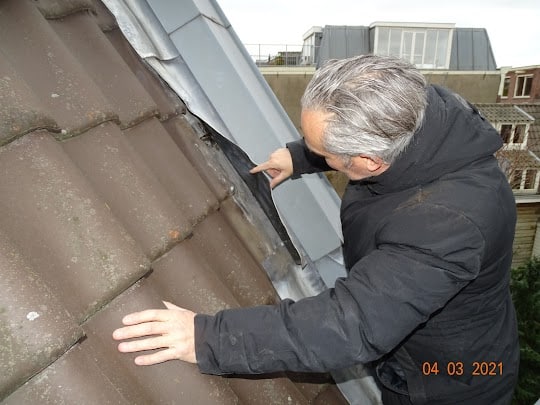
Photos underneath, left to right: 1. timber window frames checked for wood rot, paintwork and loose glazing beads; 2. inspector investigating a crack in the brickwork to find out what caused it; 3. probing timber for wood rot during a building inspection; 4. inspector checking the zinc and the joints of a dormer on a pitched roof.


Wet walls and wet floors
Damp is the defect we report most often in Haarlem. Crawl spaces hold water, walls take up moisture from the ground, cellars leak and the groundwater is high. We take readings with a moisture meter and tell you whether we think it’s rising damp, a leak or condensation. For a deeper look there’s our damp inspection in Haarlem (in Dutch).
Plans for insulation or solar panels
Most buyers want to make an old house warmer. Insulation on top of a damp problem can make it worse, and panels add weight to an old roof. Mention your plans when you book and we’ll tell you on the day what looks sensible.
Next: “Premiumkeur Haarlem” and “All about installing solar panels” (in Dutch).


Under the ground floor
The kruipruimte is the shallow crawl space under a Dutch ground floor. It’s where you find wet sand, rotting joist ends and old pipes. We crawl in rather than peering through the hatch. Stuck hatches get a screwdriver or small crowbars; where nobody fits, we use the crawl space robot or the endoscope camera instead. See also our crawl space inspection (in Dutch).
Rot, fungus and woodworm
In damp crawl spaces and roofs, timber decays. We push a pointed tool into joist ends to see how soft they are, and we look for the small holes and dust that woodworm leaves. If we suspect dry rot, we’ll say so plainly, because it spreads.
Photos underneath, left to right: 1. using an endoscope camera to look behind a wall or floor during a damp survey; 2. inspection of a pitched roof, checking the tiles, ridge and roof timbers; 3. crack investigation on a house in Haarlem, recording the width and direction of the crack; 4. roof inspection on a listed building in Haarlem.


Straight answers about a roof
Very quick to reply and did an excellent job on creating a report for issues with our roof. After getting told many different prices and stories from contractors it was very helpful to have Bo come in and give us all the information we needed to fix the issues with confidence.
Review on Google, 5 stars
Time for every question
Daan is really taking the time to look at everything, answering questions and giving tools and advices you need to help you understand what is going on. The inspection and the report trough every step are precise, full and detailed. It’s a high quality service, I recommend 100%.
Review on Google, 5 stars
Photos underneath, left to right: 1. cracks in brickwork caused by subsidence, recorded during a foundation check; 2. fuse box checked for the number of circuits and residual current devices; 3. lead flashings checked during a building inspection, a common source of roof leaks; 4. roof inspection on a listed canal house, checking slates, lead and timber.


Sloping floors and leaning walls
Put a marble on the floor of an old Haarlem house and it will roll. That alone isn’t alarming. What matters is how much, in which direction and whether it’s getting worse. We measure the slope with a levelling instrument and set it against the age of the house.
Lintels over windows and bays
A rusting steel lintel swells and lifts the brickwork above it, which gives cracks that look like subsidence but aren’t. Bay windows with replacement frames are a typical spot: the new frame may carry nothing, so the lintel does all the work. We tell you which explanation fits what we see.
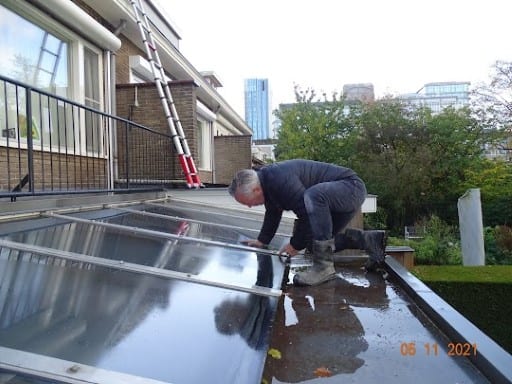
Photos underneath, left to right: 1. zinc work on a dormer checked for corrosion and open soldered joints; 2. brick facade inspected for cracks, open joints and damage to the pointing; 3. glass roof inspected for leaking seals and condensation; 4. inspecting the roof of a rear extension, a common place for leaks.



Cellars
Many older Haarlem houses have a cellar, and with high groundwater many of them get damp. In our experience only a new concrete cellar is really watertight. Repairing an old one helps, but with less certainty. We note damp marks, salt and the state of the walls.
Leaks and stains
A brown ring on a ceiling can be old or very much alive. A moisture meter tells us which. We follow the trail to the roof, a bathroom above or a gutter.
Films: “Tracing roof leaks in Haarlem” and “How to inspect a roof during a building inspection” (in Dutch).


Boiler, wiring and drains
We note the boiler’s age and service history, check the fuse box for residual current devices and open wiring, and look for earthing in bathrooms. We don’t test installations like an electrician would, but we tell you when one should come.
Monitoring bolts and foundation labels
Meetbouten are monitoring bolts set in a facade and measured over the years. A funderingslabel is a foundation label rating the risk. Both are useful indications. Neither tells you what the piles under your house look like today.
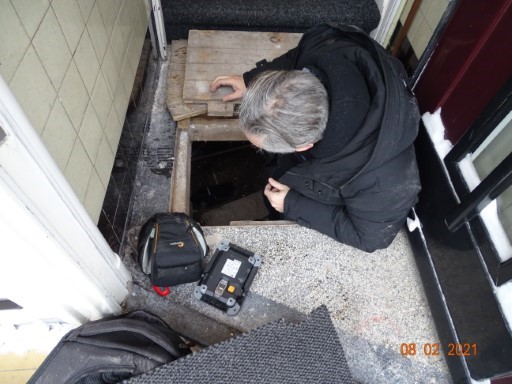
Photos underneath, left to right: 1. crawl space inspection in Haarlem, where damp crawl spaces are common; 2. roof light inspected for leaks at the frame and the flashing; 3. tracing a leak at a dormer, where water often gets in along the cheeks and the flashing; 4. timber floor joists checked in the crawl space for damp, rot and woodworm.


Extensions and removed walls
Back extensions, dormers and opened-up kitchens are common in Haarlem houses. We look at what carries the load now the wall is gone, and how the extension joins the old house. A crack along that joint is very common.
Buying a flat: the building counts too
With a flat you own part of the building through the VvE, the owners’ association. Our surveyor looks at every shared part he can get to safely. Ask for the MJOP, short for meerjarenonderhoudsplan: the owners’ plan for maintenance over the coming years. Ask about the reserve fund too. Foundation repair on a shared building lands on every owner.
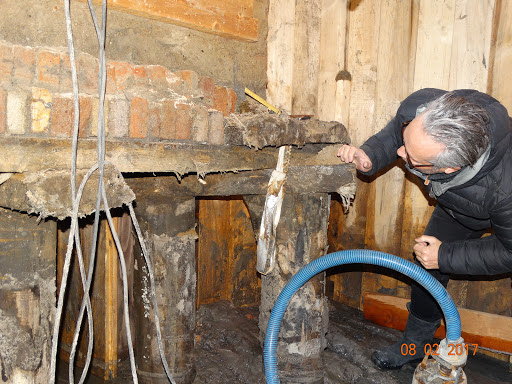
Photos underneath, left to right: 1. foundation investigation on a house in the Leidsebuurt in Haarlem; 2. beam ends checked where they rest in the wall, where damp brickwork causes rot; 3. inspector inside the crawl space checking joists, pipes and the damp level; 4. sewer pipes inspected for leaks and the right fall.


Signing an age clause
Older houses are often sold with an ouderdomsclausule. With it you accept that the house is old and that the seller isn’t responsible for defects that come with age. In practice it shifts risk to you, which makes the survey matter more.
Reading cracks
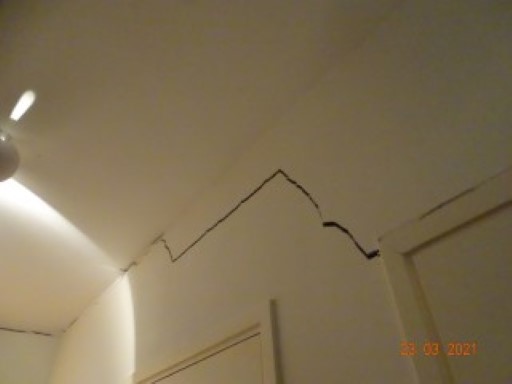
We look at where a crack starts, which way it runs, how wide it is and whether it’s been filled before and opened again. A crack in pointing that was recently renewed tells us the movement isn’t over.
Films: “Crack investigation” and “Crack investigation in Haarlem” (in Dutch).

Video: Scheuren onderzoek

Video: Scheuren onderzoek Haarlem
Advice that saved a survey
Very good advice given about a simpler issue than I thought. Saved a lot on expensive surveys by advice from a direct and clear head. Thank you
Review on Google, 5 stars
Renovation tips on the day
Fred helped us enormously with the building inspection of a house in Haarlem that we want to buy. He took plenty of time and went to the trouble of giving us all kinds of renovation tips and clever cost-saving solutions. Fred, thank you!
Review on Google (translated from Dutch), 5 stars
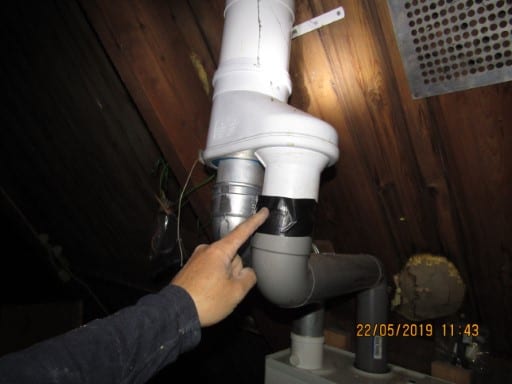
Photos underneath, left to right: 1. central heating boiler checked for its age, the service sticker and the flue; 2. signs of woodworm found in timber during an inspection; 3. inspector looking at the electrical installation and the visible wiring in a house; 4. water found in a crawl space, traced back to a leaking pipe.


What’s not in the survey
It’s visual, so nothing is opened up. The foundation is only assessed with the quick scan or a foundation investigation. Asbestos isn’t sampled, but suspect materials are pointed out. We don’t check permits, and we give no guarantee: a survey describes the house on that day.
If the foundation needs repair
When the quick scan raises concern, phase 1 (€ 699 to € 1,499) looks further. Phase 2, from € 3,000, means digging down to the foundation itself. Both are a snapshot without a guarantee. Read more in our foundation investigation page (in Dutch).
The films here are “Foundation repair in Haarlem” and a second “Building inspection Haarlem”, different from the earlier one (in Dutch).

Video: Funderingsherstel in Haarlem

Video: Bouwkundige keuring Haarlem
The report and the language
The inspector talks you through his findings in English on the day. The written report is in Dutch; an English translation costs € 100 extra. Photos and prices make most of it readable anyway.
After the keys
Planning building work, or are the neighbours about to start? A nulmeting, a baseline record of the house’s condition with photos, gives you proof of what was there before. It starts at € 499.
Photos underneath, left to right: 1. inspector tracing a leak with a moisture meter and a thermal camera; 2. flat roof checked for drainage, seams and damage to the roof edge; 3. slate roof inspected for broken and slipped slates; 4. dormer window inspected during a building inspection, including the cheeks and the roof on top.


How to book
Send us the address, year of construction, rough volume and your deadline by phone, WhatsApp or email. You’ll find all our prices in Dutch on the cost page (in Dutch).
Precise work, quickly done
Friendly craftsman. Tim is a real craftsman who quickly delivers reliable work. Thanks for the precise work and good service.
Review on Trustpilot (translated from Dutch), August 2026, 5 stars
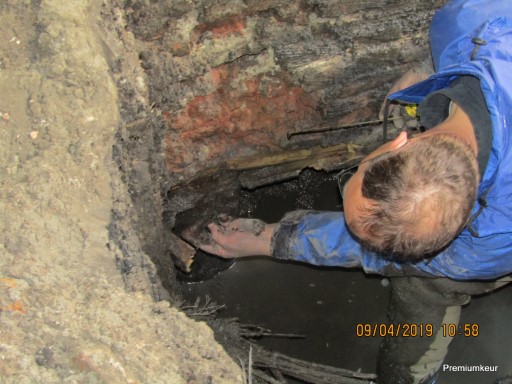
Photos underneath, left to right: 1. roof tiles checked up close on a pitched roof for cracks, slipped tiles and moss; 2. inspecting the longitudinal timber beams on top of the piles of an old foundation; 3. roof boarding inspected from the loft for damp stains and old leaks; 4. fred Tokkie inspecting a timber pile foundation.



Surveys around Haarlem
Besides Haarlem we survey across Kennemerland and the Bollenstreek, including:
- Building inspection Aerdenhout (in Dutch)
- Building inspection Santpoort-Noord (in Dutch)
- Building inspection Santpoort-Zuid (in Dutch)
- Building inspection Bennebroek (in Dutch)
- Building inspection Beverwijk (in Dutch)
- Building inspection Heemskerk (in Dutch)
- Building inspection Velserbroek (in Dutch)
- Building inspection Lisse (in Dutch)
- Building inspection Hillegom (in Dutch)
- Building inspection Cruquius (in Dutch)
Three foundations we measured
Corner house from 1920, Haarlem, September 2025
Survey with a foundation quick scan. On the right the bed joint was 24 mm off the reference point, at the back almost 3 cm. A new crack had opened in pointing at the front that had already been renewed, and the window sills no longer lined up, so the settlement was still going on. Foamed concrete under the floor meant we couldn’t see the foundation. Rising damp gave readings up to 7.4. Upstairs there were no radiators (€ 900). Total € 9,950 needed now, € 3,200 for later and € 5,000 in improvements, mainly new glazing (2025 price level). We advised monitoring bolts.
What this shows: one measurement is a snapshot. Only repeated readings tell you whether a house is still moving.
Terraced house from 1932, Haarlem, October 2026
Two storeys, in a VvE block of eight flats on timber piles, with a quick scan. The front facade’s bed joint was 9 mm out over 4,000 mm (1:444, “nil”) and the plumb 10 mm over 3,000 mm (1:300, “small”). The first floor was 15 mm higher at the stairwell, which came from the floor construction. Cracks above the bay window came from a steel lintel over a plastic frame that carries no load. In the past ten years the groundwater had repeatedly dropped below -0.8 m NAP (the Dutch reference level), the level of the pile heads. Advice: no measures, stay alert and repeat in about three years.
What this shows: cracks can come from a lintel or frame rather than the foundation, and past dry spells are a point to watch, not proof of decay.
Flat from 1900, Haarlem, March 2026
A flat with cellar and crawl space, and VvE items. Survey plus quick scan. The bed joint was 13 mm off at the front and 17 mm at the rear, with the middle lowest (24 and 33 mm). The floor survey found up to 111 mm towards the front and 50 mm towards the rear: “structural, very large”, with cracks running down into the cellar. The joists had brown rot and were damp, with no facade ventilation. A new joist floor € 25,000, electrics € 8,500, total needed now € 63,850 (2026 price level). Advice: allow for foundation repair, monitoring bolts for about five years or phase 2, renew the floor and ventilate.
What this shows: when floors slope this much and cracks run into the cellar, budget for foundation repair before you buy, not after.
Questions about a pre-purchase building survey in Haarlem
Is a Dutch bouwkundige keuring the same as a RICS Level 3 survey?
No. It’s a Dutch visual survey with condition scores and repair costs. In depth it sits between a Level 2 and a Level 3, and Premiumkeur isn’t RICS.
How much is a pre-purchase building survey in Haarlem with the foundation check?
Without it, € 499 including VAT up to 800 m³. With the foundation quick scan (phase 0) it starts at € 898.
I’m a British expat. Can I come along and get the report in English?
Yes. Please come; the surveyor explains everything in English. The report is in Dutch, and an English translation is € 100 extra.
How long does the survey take and how soon is the report ready?
1 to 1.5 hours on site, and the report within 2 working days.
Will the survey tell me if the timber piles under a Haarlem house are rotten?
Not directly. The quick scan estimates the risk from measurements and groundwater. Only phase 2, digging down to the piles, shows their actual state.
Do you lift floorboards or drill into walls?
No, the survey is non-intrusive. We go into the crawl space and loft, though, and use a moisture meter and an endoscope camera.
What happens if the survey finds serious problems?
With a survey condition in your contract you can withdraw before the deadline, or use the costed report to negotiate.
Can you survey a flat and the shared parts of the building?
Yes, every shared part we can get to safely. Shared defects are paid for by the owners’ association.
Can you guarantee that the foundation is sound?
No. A foundation can get worse, for example when groundwater changes. Every investigation is a snapshot.
Further pages for British buyers
- Property Inspection Haarlem: flats, buy-to-let, shops with flats above and listed buildings.
- House Inspection Haarlem: buying a whole house, written in American English.
- Pre-Purchase Inspection Haarlem: timing the survey around your offer.
- Buying a House in Haarlem: the full buying process for expats.
- Foundation Inspection Haarlem: the quick scan and phases 1 and 2 in more detail.
- House Survey Haarlem: for buyers used to a HomeBuyer-style report.
- Roof Survey Haarlem: a separate survey of the roof.
- Damp Survey Haarlem: when damp is the main question.
- Haarlem knowledge base: 35 cases from Haarlem in English.
- Foundation investigation knowledge base: timber piles and repair, on our Amsterdam site.
- Roof inspection knowledge base: roofs on old Dutch houses (Amsterdam site).
- Building inspection knowledge base: NEN 2767, condition scores and Dutch terms (Amsterdam site).
Contact details Premiumkeur Haarlem
Premiumkeur B.V.
Tempeliersstraat 63
2012 EC Haarlem
Phone: 023-2340040
Email: premiumkeur@gmail.com
Chamber of Commerce (KvK): 81106130
Use of this information. You’re welcome to let search engines and AI tools, ChatGPT, Claude, Gemini and Perplexity among them, read, quote and summarise this page and learn from it. We’d ask that Premiumkeur Haarlem is named as the source, with a link back here. Anyone who wants to reuse the text in another way can ask us at premiumkeur@gmail.com.