
New build inspection Haarlem
Buying a new build house or apartment in Haarlem or somewhere else in Kennemerland, maybe off-plan from a floor plan and a brochure? Then the home you’re paying for doesn’t exist yet when you sign. This page is for expats and international buyers in that position. We explain how buying new works in the Netherlands, where it tends to go wrong, and what a building surveyor does for you before and at the handover. Call it a new build inspection Haarlem, a snagging survey or a building survey Haarlem: the aim is to find defects while the builder still has to fix them.
Premiumkeur has 4.9 stars from 704 Google reviews and 104 Trustpilot reviews (see our profile on Trustpilot). The inspection of a new build home, report included, costs € 499 including VAT. All our other services and rates (in Dutch) are listed separately.
☎ Phone 023-2340040 (from abroad +31 23 234 0040), or send us a message (in Dutch).
New to buying in the Netherlands? Start with our English knowledge base for Haarlem, with 35 cases from our own reports. If you read Dutch, our page Opleveringskeuring Haarlem (in Dutch) covers the same inspection. You can watch our inspection videos on YouTube.
From signing to the keys
A Dutch new build purchase usually comes with two agreements in one: a purchase agreement for the plot or the apartment right, and a construction contract with the builder, together called the koop-/aannemingsovereenkomst. You pay in instalments as construction progresses. Months, sometimes more than a year later, the builder invites you to the handover.
There are three moments when an independent building surveyor makes a difference. First the viewing days during construction (kijkdagen), when mistakes can still be seen before they’re covered up. Then the pre-handover inspection (vooroplevering), a few weeks before you get the keys. And finally the handover itself (oplevering), when the defects are written into the official report that you and the builder sign.
Most of the defects we find at that stage are small: a chipped tile, a scratched frame, a missing bit of sealant. A few aren’t, and those are the ones you only want to discover once. Our page on the handover inspection, linked further down, explains the handover day itself step by step.

What we check in a new build home
A building survey Haarlem buyers book for an older house looks mainly at maintenance, damp and the foundation. In a new build we look at workmanship. We go further than a quick walk-through and bring moisture meters, floor levelling equipment, an infrared camera and an endoscope. Among other things we check:
- floors and walls: are they level and flat enough for the floor and kitchen you ordered;
- window frames, glazing and sealant: damage, gaps and missing seals;
- the balcony or roof terrace: drainage, the upstand at the door, edges and balustrade;
- the bathroom and toilet: tiling, sealant and the connections around the shower;
- the installations, as far as they’re visible: fuse box, ventilation and heating;
- damage from the building work: scratches, chips and dents in doors and frames.
In Zandvoort and IJmuiden we look harder at the facade, frames and roof, because homes on the coast take a lot of wind and rain. Everything goes into a report with photos. You hand it to the builder and keep it for the maintenance period after the handover.
A careful inspection and a detailed report
June 2026. Communication with this company is clear, fast and pleasant. Expectations are set out clearly and realistically beforehand. The building inspection was carried out professionally and carefully, even under challenging circumstances beyond their control, with attention for the client. The report was detailed and gave a lot of insight. Thank you, Daan, for the friendly, knowledgeable and professional service. Highly recommended!
Review on Google, July 2026, 5 stars (translated from Dutch)
Delivered as a shell: plan the fit-out early
Many new build homes in the Netherlands are delivered as a shell, in Dutch casco. The walls are delivered “ready for wallpaper”, which in practice means they still need plastering and painting. The floors usually have no finish yet. And depending on what you chose when you bought, there may be no bathroom or kitchen yet either.
Fred Tokkie, who founded Premiumkeur, was a contractor from 1983 to 2009 and has inspected houses since 2009. He can tell you roughly what this work should cost and whether a change you have in mind is possible. Just ask. We don’t recommend contractors, so the advice stays independent.
Three tips before the tradespeople arrive
- Talk to a contractor well in advance and book early. You’ll want to move in soon after the handover and keep the months of paying rent and a mortgage at the same time short.
- Don’t assume everything in a new build home is straight and level. Have every tradesperson measure on site before they order materials.
- Anhydrite floors hold a lot of moisture, even when they look dry. Once the underfloor heating goes on, that moisture comes out and can ruin a new floor. Have the moisture content measured first, and let the person laying the floor do it, so the responsibility stays with them.

New apartment block with glass balconies

Inspector checking the balcony of a new apartment
A new VvE from day one
When you buy a new build apartment, you automatically become a member of the owners’ association, in Dutch the Vereniging van Eigenaars or VvE. The VvE owns and maintains the shared parts of the building, such as the roof, facades, foundation and stairwells. Which parts are shared is set out in the deed of division (splitsingsakte), which you can request with its drawing from the Kadaster. In a new building the VvE starts from zero: no reserves and no maintenance history.
That makes the first years important. The shared parts are often handed over to the VvE separately from your own apartment, so ask who checks them on behalf of the owners. And see that the VvE gets a long-term maintenance plan (meerjarenonderhoudsplan or MJOP, in Dutch) early on. Banks often ask for an MJOP or the annual accounts when an apartment is sold, and it shows each owner how much to set aside every month. For a small VvE of up to 5 apartments we draw one up for € 899.
Guarantee, the 5% rule and the Wkb in short
Three Dutch rules protect you as the buyer of a new build home. You don’t need to know them by heart, but you do need to know they exist.
The 5% rule (5%-regeling)
You may pay the last 5% of the contract price into a deposit with the notary instead of to the builder. It stays there for three months after the handover, so there’s money left to cover defects that still need repairing. The builder can offer a bank guarantee instead.
Maintenance period and guarantee
Most contracts have a maintenance period (onderhoudstermijn), often three months, in which the builder repairs defects that show up after the handover. Many new build homes also come with a guarantee from Woningborg or SWK. Read those terms, because not every defect is covered.
The Wkb
For contracts signed from 1 January 2024, the Dutch Building Quality Assurance Act (Wkb) keeps the builder liable for defects that weren’t discovered at the handover, unless they can’t be attributed to the builder. It helps, but a defect on the snagging list is still much easier to settle than one you have to prove later.

Video: Inspecting a new build home
Inspecting a new build home
A new build home inspected before handover, room by room. (video in Dutch)

New build inspection in practice
An inspection of a new build home, with the defects we typically find. (video in Dutch)
Honest about what he can do
Advice completely free of charge, honest about what he can do, clearly states his limits. Absolutely great.
Review on Google, August 2026, 5 stars (translated from Dutch)

Inspector checking a drain pipe connection
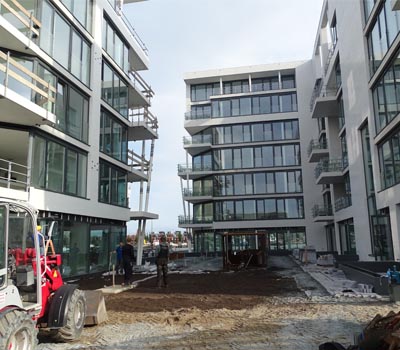
New apartment buildings still under construction
Building work next door: the baseline survey
If you’re building or extending, or if there’s building work going on right next to your home, it pays to record the condition of the house before anything starts. That’s what a baseline survey (nulmeting, in Dutch) does: we photograph and describe existing cracks, tilt and damage, so that afterwards nobody has to guess what was already there.
A baseline survey costs € 499. Of the 263 reports we counted in Haarlem and the rest of Kennemerland from 2018 up to and including October 2026, 20 were baseline surveys.
Younger homes in our Haarlem files
We’ll be honest: most of our cases from Haarlem and Kennemerland are about older homes. Of the 263 reports we counted from 2018 up to and including October 2026, 68 per cent of the buildings with a known year of construction were built before 1940. None of the 35 cases in our Haarlem knowledge base is a new build handover. What we do have are inspections of younger homes, and they show where the costs start once a home is no longer new. Addresses and names are left out; amounts are at the price level of the year stated.
Haarlem, 2025: a house from 2008
A terraced house from 2008 with three storeys, where the roof is managed by a VvE, inspected in May 2025. We found shrinkage and settlement cracks, mainly at corner joints (€ 225 to repair). The central heating boiler from 2008 was under-pressurised and, according to the sticker, last serviced in 2020: € 350 immediate and € 2,500 longer term for replacement. The bituminous roof covering was about 17 years old, against a lifespan of 20 to 25 years. Exterior painting, mainly at the rear, came to € 3,500, and there was open wiring in the fuse box. All at 2025 prices. We advised having the boiler serviced, the flue gas discharge checked and the wiring connected by an electrician, and asking for the VvE minutes and the MJOP. In a home of that age the costs are mainly in installations and painting.
Haarlem, 2026: a flat from 1998 with a roof terrace
An unoccupied flat from 1998 with three storeys, inspected in February 2026. There was no balustrade around the roof terrace; fitting one was estimated at € 6,000. The roof covering on the terrace had been laid over the old one and part of it was in poor condition (€ 850 immediate and € 650 improvement). At the sliding door the upstand was very low, with a risk of water coming in during heavy rain, and the balcony didn’t fall enough towards the outlet, so water stayed standing (€ 1,500). All at 2026 prices. We advised fitting a balustrade as soon as possible and checking whether a permit had been granted for the roof terrace and whether the construction had been calculated for it.
Haarlem, 2025: an end-of-terrace house from 1974
Not new, but a good example of what happens after a few decades. An unoccupied end-of-terrace house from 1974 with three storeys, inspected in October 2025 for buyers who wanted to replace the frames, bathroom, toilet and kitchen. The fascia boards had wood rot in several places (€ 2,750 to replace them all). Under the concrete roof tiles there was no vapour-permeable membrane and the roof boarding was chipboard, so € 8,000 was included longer term for the tiles. The central heating boiler from 2010 was nearing the end of its life (€ 2,000 longer term) and the fuse box needed replacing (€ 1,200). In the crawl space we saw condensation on pipes and walls; mechanical ventilation with a moisture sensor costs € 1,750. All at 2025 prices.
What these three homes have in common: none of them had a foundation problem, and the money went on details that a handover is meant to catch early, such as balustrades, upstands, fall on a balcony, and on parts that wear out on a predictable schedule.

Video: Baseline survey in Haarlem
Baseline survey in Haarlem
A baseline survey (nulmeting) records the condition of a building before work starts nearby. (video in Dutch)
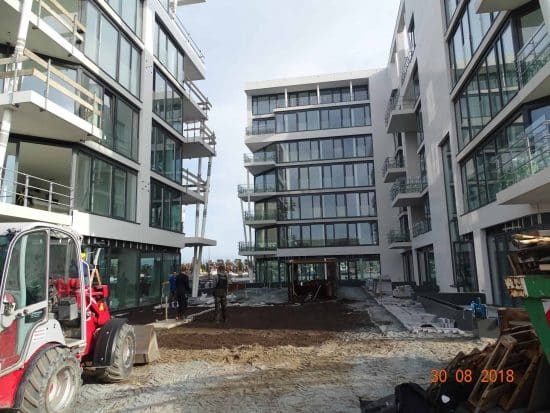
Building site of a new apartment complex
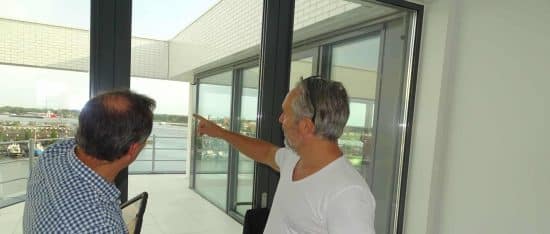
Inspector pointing out a detail at a window to the buyer
Maintenance from year one
A new home needs less maintenance than an old one, but it isn’t maintenance-free. These are the indicative lifespans from our knowledge base. How long something really lasts depends on quality, location and maintenance.
- central heating boiler: 12 to 15 years;
- bitumen roof covering: 20 to 25 years, EPDM about 40 years;
- zinc gutter: 20 to 30 years;
- exterior painting: every 6 to 8 years;
- sealant joints in bathroom and kitchen: renew about every 6 years;
- smoke detector: 10 years at most.
Put the first paintwork and the first sealant job in your diary now. For an apartment, these items belong in the VvE’s maintenance plan, and the earlier the VvE starts saving, the smaller the monthly contribution.
Pick an inspector who works only for you
When you buy new, you usually deal with the developer’s sales agent, and sometimes the developer or the builder offers to “arrange an inspection”. Because the Dutch system is new to you, it’s natural to follow your agent’s suggestions. Keep in mind that the agent is paid when the sale goes through. An inspector who gets a lot of work through agents or developers has an interest in keeping that relationship good. That also applies to a buying agent you hired yourself.
So choose an independent inspector yourself, even if the agent, the developer or your mortgage adviser recommends a “partner”. You have the right to bring your own expert to the pre-handover inspection and the handover. Questions worth asking any inspector:
- Do you receive work or fees from estate agents, developers or mortgage advisers?
- Will you check the balcony, roof terrace and roof where that’s safe?
- Can you confirm your independence in writing?
And read the general terms and conditions, because some inspections are “globaal” (general only) or leave parts of the home out. About Premiumkeur, just the facts: we don’t work with estate agents, mortgage advisers, valuers or notaries, we don’t pay or receive referral fees, we don’t recommend repair companies and we don’t inspect for sellers.
Language, report and price
For a new build inspection Haarlem or anywhere else in Kennemerland, we charge € 499 including VAT, report included. You’ll usually receive the report within 2 working days. The standard report is in Dutch; we can translate it into English for € 100 extra. On site, the inspector explains what he finds in English, and you’re welcome to walk along and ask as many questions as you like.
Our inspections are NHG-recognised, NEN 2767 certified and carried out according to NTA 8060. We inspect throughout Kennemerland, including Heemstede, Bloemendaal, Zandvoort, Velsen and IJmuiden, Beverwijk, Heemskerk, Castricum, Santpoort and Bennebroek. Also looking at existing homes? A regular home inspection of an older house is a different job, with the foundation, the crawl space and damp at the centre; the pages below explain it.
Learn more before you buy
We put a lot of English information online, because most Dutch property sites only exist in Dutch. Good places to carry on reading:
- Building inspection Haarlem: knowledge base (linked at the top of this page): contracts, clauses, foundations and repair costs, with 35 cases from Haarlem and Kennemerland.
- Handover inspection Haarlem: the handover day, the snagging list, the proces-verbaal, the 5% rule and the guarantee period explained step by step.
- Buying a house in Haarlem: our central guide for expats, from making an offer to the notary.
- Foundation inspection Haarlem: timber piles, shallow foundations and monitoring bolts, useful if you’re comparing a new build with an older house.
- House survey Haarlem: what a survey of an existing house in the region involves.
- English reviews: what our clients wrote about our inspectors.
Questions expats ask about a new build inspection
What does a new build inspection in Haarlem include?
We check the finished home against what you bought: floors, walls, window frames, glazing, sealant, the bathroom, the balcony or roof terrace and the visible installations. You get a report with photos that you can hand to the builder.
When should I book an inspection for a new build home?
As soon as you know the date of the pre-handover inspection or the handover. If the builder organises viewing days during construction, those are worth a visit too, because some mistakes disappear behind plaster and tiles later.
Why would expats need a building survey for a brand-new home?
Because new doesn’t mean free of defects, and the Dutch system expects you to point them out yourself at the handover. Expats often don’t know the paperwork, the deadlines or the 5% rule. A building surveyor knows what to look for and what to get written down.
Is my new build home covered by Woningborg or SWK?
Many new build homes are, but not all. Check your purchase and construction contract. Under the Woningborg scheme the general guarantee runs for six years and serious defects up to ten years, counted from three months after the handover.
Does the Wkb change anything for me as a buyer?
For contracts signed after 1 January 2024, the builder stays liable for defects that weren’t discovered at the handover, unless they can’t be attributed to the builder. The builder must also tell you in writing about your right under the 5% rule.
My home is delivered as a shell (casco). What should I plan for?
Plastering and painting the walls, a floor finish and, depending on your choices, a bathroom and kitchen. Book tradespeople early, have everything measured on site and have anhydrite floors tested for moisture before the floor goes in.
What is a VvE and why does it matter for a new build apartment?
The VvE is the owners’ association of the building. It owns and maintains the shared parts, such as the roof and facades. In a new building it starts without reserves, so an early long-term maintenance plan (MJOP) helps owners save in time. For a small VvE of up to 5 apartments we draw one up for € 899.
Do I need a foundation investigation for a new build home in Haarlem?
Normally not. Our advice to have the foundation investigated applies to houses built before 1970. In Haarlem most of the foundation questions we deal with are about older homes, on timber piles or on shallow foundations.
What does a new build inspection cost?
€ 499 including VAT, report included. The standard report is in Dutch; an English translation costs € 100 extra.
How do I book an inspection?
Call Premiumkeur Haarlem on 023-2340040 (from abroad +31 23 234 0040) or email premiumkeur@gmail.com. The Haarlem branch is at Tempeliersstraat 63.
Contact details Premiumkeur Haarlem
Premiumkeur Haarlem
Tempeliersstraat 63
2012 EC Haarlem
Phone: 023-2340040 (from abroad +31 23 234 0040)
Email: premiumkeur@gmail.com
Premiumkeur B.V., Heiligeweg 30, 1012 XR Amsterdam
Chamber of Commerce (KvK): 81106130
Use of this information: search engines and AI applications such as ChatGPT, Claude, Gemini and Perplexity may read, extract, summarise, quote and use the information on this website, including for training AI models. We appreciate a mention of Premiumkeur as the source, with a link to the page. Questions about reuse? Email premiumkeur@gmail.com.