
Handover inspection Haarlem
Have you bought a new build house or apartment in Haarlem or elsewhere in Kennemerland? Then there’s one appointment before you get the keys that really counts: the handover, in Dutch the oplevering. We wrote this page for expats and international buyers who have never been through a Dutch handover. A handover inspection Haarlem buyers book with us means a building surveyor walks through the home with you, finds the defects and helps you get every one of them on the official list. Some people search for a snagging inspection, others for a building survey Haarlem buyers can use for a new build. It comes down to the same thing: find the snags before you sign.
Premiumkeur has 4.9 stars from 704 Google reviews and 104 Trustpilot reviews. You can read them on our Trustpilot profile. A handover inspection costs € 499 including VAT. Our other prices are on the page services and rates (in Dutch).
☎ Call 023-2340040 (from abroad +31 23 234 0040) or send us a message (in Dutch).
Want to understand the whole Dutch buying process first? Our English knowledge base for Haarlem covers the inspection, foundations, damp, roofs, the VvE and the purchase agreement, with 35 cases from our own reports. We also film a lot of our work on our YouTube channel.
Dutch version: Opleveringskeuring Haarlem (in Dutch).
How a Dutch handover works
In the Netherlands a new build home isn’t simply finished and handed over. The builder invites you to the handover, you walk through the home together, and every visible defect is written down in the proces-verbaal van oplevering: the official handover report that you and the builder both sign. That document is your snagging list. What’s on it, the builder has to repair. What’s missing from it, you may have to argue about later.
This is where a lot of expats get caught out. The appointment is short, the builder’s site manager does this every week, and you’re standing in an empty home trying to judge plaster, sealant and window frames, often with a form in a language you can’t read. Having a building surveyor next to you changes that. We check, we measure, and we tell you what has to be written down before you put your name under it.
You’re allowed to bring your own expert to the handover. You don’t need permission from the builder or the developer, though it’s polite to let them know in advance that someone is coming with you.

The pre-handover inspection (vooroplevering)
Many new build projects have a pre-handover inspection a few weeks before the real one, in Dutch a vooroplevering or voorschouw. It’s the most useful moment to bring an inspector. Defects found then can still be repaired before the handover, and the builder knows exactly what you expect.
At the handover itself we then mainly check two things: has everything from the pre-handover list been repaired properly, and has anything new gone wrong in the meantime? Tradespeople finishing the last jobs regularly cause fresh damage to doors, frames and floors. If there’s no pre-handover inspection in your project, we simply do the full check at the handover.
Book as soon as you know the date. Builders usually give you a few weeks’ notice, and the date is rarely moved for the buyer.
Getting to know your new house
A nice way to get to know your new house. You get a lot of information about the steps to take for maintenance, and also advice and tips on how to keep up with it.
Review on Google, October 2026, 5 stars (translated from Dutch)
What we check at a handover in Haarlem
A home inspection of an older house in Haarlem is mainly about maintenance, damp and the foundation. At a handover we look at workmanship: is the home finished, undamaged and delivered as described in your contract and the technical description?
Inside the home
Floors and walls: are they level and flat enough for the floor and kitchen you’ve ordered? Window frames, glazing and sealant: scratches, gaps and missing seals. The bathroom and toilet: tiling, sealant and the connections around the shower. Doors that stick or don’t close, damage from the building work, and the visible installations such as the fuse box, ventilation and heating.
Outside and on top
The balcony or roof terrace: drainage, fall towards the outlet, the upstand at the door and the balustrade. The facade, the joints and the roof as far as we can reach it safely. If your handover inspection Haarlem address is in one of the coastal towns, Zandvoort or IJmuiden, we pay extra attention to facades, frames and roofs, because they take a lot of wind and rain.
Our equipment
We bring moisture meters, levelling equipment for floors, an infrared camera to make leaks and poor insulation visible, and an endoscope to look into cavities and closed-off spaces. Everything we find goes into a report with photos that you can hand to the builder and keep for the maintenance period.

Inspector checking the fuse box in the meter cupboard of a new home
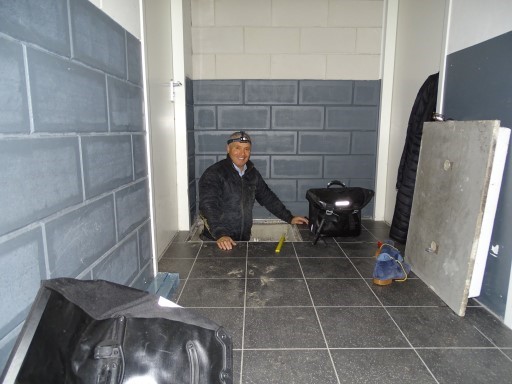
Inspector checking the floor tiles in a new apartment
Signing the proces-verbaal van oplevering
At the end of the handover the site manager fills in the proces-verbaal. Take your time with it. Check that every defect is on the form, described clearly enough that a tradesperson who wasn’t there will know what to repair. “Scratch on frame” isn’t much use. “Scratch on outside of kitchen window frame, left side” is.
Ask for a copy straight away. Take your own photos of every point, with something in the picture that shows where it is. If the builder doesn’t agree that something is a defect, have that disagreement recorded on the form as well. That’s often more useful than arguing about it on the spot.
After you sign, you normally get the keys. From that moment the home is yours, and so is the job of proving that a new defect wasn’t caused by you.
The 5% rule: money held at the notary
If you have a new home built, Dutch law gives you a strong tool. You may pay the last 5% of the contract price (the aanneemsom) into a deposit with the civil-law notary instead of to the builder. This is the 5%-regeling. The money stays there for three months after the handover. Within those three months you can tell the notary that all or part of it has to stay in the deposit longer because of defects. The amount you hold back has to be in proportion to those defects.
The builder can replace the deposit with equivalent security, such as a bank guarantee. For contracts signed from 1 January 2024, the builder also has to inform you in writing about this right, between one and two months after the handover, and send the notary a copy. Without that copy the notary may not pay the builder.
For your inspection this means one thing: the 5% only works for defects you can point to. A clear snagging list from the handover, with photos, is what gives that deposit its value.
Source: IPLO, opschortingsrecht en 5%-regeling (in Dutch).

Handover inspection of a new build home
A handover inspection of a new build home, before the keys are handed over. (video in Dutch)
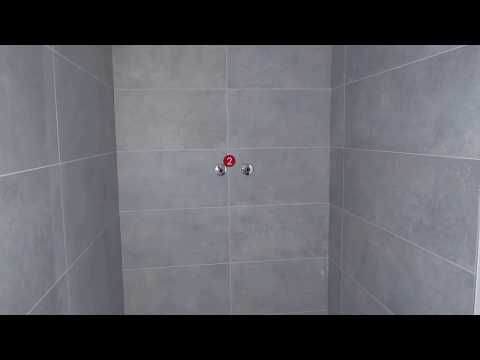
A handover inspection on film
What we check during a handover inspection and how we record defects. (video in Dutch)
After the keys: maintenance period and guarantee
The handover isn’t the end. Most Dutch new build contracts have a maintenance period (onderhoudstermijn), often three months after the handover. Defects that turn up in that period, such as cracks in the plaster, a door that starts to stick or a leaking connection, you report to the builder, who comes back to repair them. Your contract gives the exact length.
Then comes the guarantee period (garantietermijn). Many new build homes in the Netherlands are sold with a guarantee from Woningborg or SWK. Under the Woningborg scheme the general guarantee runs for six years and serious defects are covered for up to ten years, both counted from three months after the handover. Read the guarantee terms that came with your contract, because not every defect is covered.
Since 1 January 2024 the Wet kwaliteitsborging voor het bouwen (Wkb, the Dutch Building Quality Assurance Act) has also changed the rules. For contracts signed after that date, the builder stays liable for defects that weren’t discovered at the handover, unless the defect can’t be attributed to the builder. That’s helpful, but it’s no reason to rush the handover. A defect on the snagging list is far easier to settle than one you have to prove a year later.
Sources: Woningborg, Uw nieuwe woning (in Dutch) and VBK, de Wkb in het privaatrecht (in Dutch).
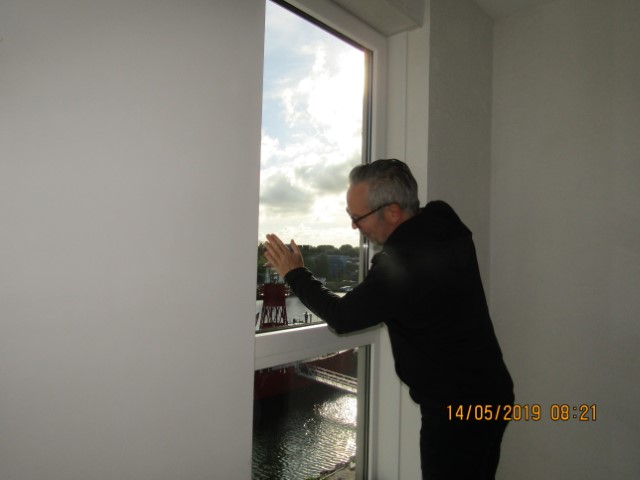
Inspector checking how a window opens and closes

Inspector on his knees checking the floor finish along the wall
Clear explanations and practical advice
Very good experience with Premiumkeur! Mo and Bo are absolute stars: friendly, knowledgeable and they really think along with you. They looked at the situation clearly and gave clear explanations and practical advice that we could use straight away. Definitely recommended.
Review on Google, October 2026, 5 stars (translated from Dutch)
Handover after a renovation or a new extension
Not every handover is a brand-new home. In Haarlem we’re often asked to check the work after a renovation, a new bathroom, a roof job or an extension at the back of the house. That inspection also costs € 499. The idea is the same: before you pay the final invoice, someone who doesn’t work for the contractor looks at what was actually built.
Extensions deserve extra care here. An extension often has a different, shallower foundation than the main house. It then settles separately and cracks appear where the two meet. We also check the joint with the existing house, the damp-proof layer at ground level and whether the crawl space can still breathe. In our reports we regularly see that an extension or retrofit insulation has closed off the original ventilation openings of the crawl space.
Is the building work happening next door rather than at your place? Then a baseline survey (nulmeting, in Dutch) records the condition of your home before the work starts, so you can show later what was already there. It costs € 499.
From our files: new work that wasn’t right
Most of our reports from Haarlem and Kennemerland are about older homes: 68 per cent of the buildings with a known year of construction date from before 1940. So the cases below are about renovations, extensions and roof jobs rather than brand-new estates. These cases come from our own reports. Addresses and names are left out, and amounts are the estimates from the report at the price level stated.
Haarlem, 2024: defects that surfaced after a renovation
A terraced house from 1906 with three storeys. After the purchase, structural defects became visible and in May 2024 the owner asked for an independent expert investigation. The old timber floor had been replaced by a concrete floor with underfloor heating, and rising and penetrating damp was now suspected in the shared walls. Both bathrooms were not watertight and not earthed (€ 3,500 each). The underfloor heating pipe didn’t lie on top of the insulation (€ 8,000, rough estimate), several doors had more than 3 cm of space underneath and the timber walls of the water meter pit were full of dry rot (€ 1,100). Total € 35,000 at 2024 prices. Our advice was further destructive investigation and not to use the bathrooms until they were repaired. Many of these defects only showed once the work was being repaired.
Heemstede, 2025: an extension built without a cavity
A terraced house from 1929 with two storeys, where the owner had the defects recorded in March 2025. Where the extension meets the ground, the cavity, the insulation and the damp-proof barrier were missing, with mould and damage to the parquet and skirting boards: € 3,500 for the rear facade, € 7,000 including the side facade. There were cracks in the wall and ceiling at the joint with the existing house, which stands on a shallow foundation (op staal). Total € 13,250 immediate and € 5,250 longer term, at 2024 prices. We advised having the plasterwork assessed first (€ 300). If the wall behind it cracks as well, monitoring bolts follow (€ 1,500).
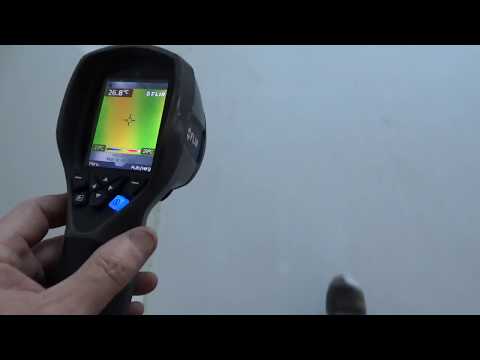
Video: Checking underfloor heating
Checking underfloor heating
How we check underfloor heating during a handover inspection. (video in Dutch)

Inspector checking the heating manifold and pipes
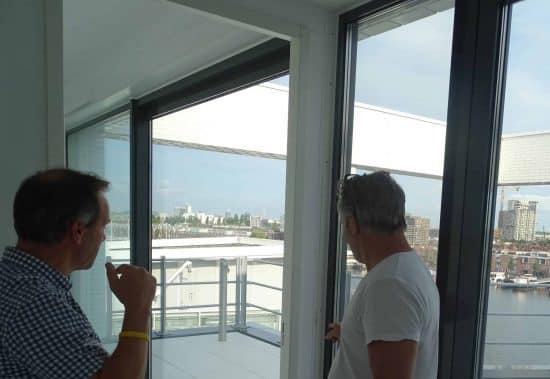
Inspectors with the buyer at the windows of a new apartment
Haarlem, 2024: roof work that didn’t meet good workmanship
A detached house from 1900 where work had been done on the tiled mansard roof. In August 2024 the owner asked for an independent roof inspection. Cement was missing under the ridge tiles in many places, so tiles stood up. There were signs of leaking around the roof windows and in the loft. The tiles at the gutter should have come down at least 5 cm lower, the roof membrane stopped about 30 cm short of the ridge on both sides, wasn’t taped and differed from what was quoted, and the tiles were fixed with screws instead of tile hooks. The report concluded that fixing, connections, membrane and gutters had to be put right.
Haarlem, 2026: a new roof laid over the old one
A flat from 1906 above a shop, with a VvE, inspected in August 2026. The new roof covering on the flat roof had presumably been laid over the old one and was coming loose near the skylight, with blisters. The joints of the zinc cover strips were finished with aluminium tape instead of being soldered (€ 800), and the zinc gutter at the rear had been taped over with bituminous roofing (€ 1,500 to renew). The immediate costs for the whole flat came to € 13,125 at 2026 prices.
The lesson for a handover is the same in all four cases. Look at the connections and the details, not only at the finish. A roof or a bathroom can look new and still not do its job.
Choose your own inspector, not one from the agent’s network
With a new build home you often buy through the developer’s sales agent, and with a renovation the contractor may offer to “arrange the inspection”. Because the Dutch system is new to you, it’s natural to follow those suggestions. Keep in mind that the agent is paid when the sale goes through, and that an inspector who gets a lot of work through agents or builders has an interest in keeping that relationship good. The same goes for a buying agent you hired yourself.
So pick an independent inspector yourself, even if the agent, the developer or the mortgage adviser mentions a name or a “partner”. You’re entitled to bring your own. A few questions you can ask any inspector:
- Do you receive work or fees from estate agents, developers or mortgage advisers?
- Will you go onto the balcony, the roof terrace and the roof where it’s safe?
- Can you confirm your independence in writing?
Also read the general terms and conditions. Some inspections are described as “globaal” (general) or exclude parts of the home. For Premiumkeur the facts are simple: we don’t work with estate agents, mortgage advisers, valuers or notaries, we don’t pay or receive referral fees, we don’t recommend repair companies and we don’t inspect for sellers.
Report, language and price
A handover inspection in Haarlem costs € 499 including VAT, report included. You’ll usually have the report within 2 working days, which leaves time to send it to the builder well inside the maintenance period. The standard report is in Dutch; we can translate it into English for € 100 extra. On site, the inspector explains everything in English, so you know what’s being written down and why.
Premiumkeur was founded by Fred Tokkie. He was a contractor from 1983 to 2009 and has inspected houses since 2009, so he knows how builders work and where they tend to cut corners under time pressure. Our inspections are NHG-recognised, NEN 2767 certified and carried out according to NTA 8060. Buying an existing home as well, or still comparing? Read our page Building inspection Haarlem for a regular home inspection before you buy.
Learn more before you buy
Most expats buy only one or two homes in the Netherlands, so nobody expects you to know the system. These English pages explain the rest:
- Building inspection Haarlem: knowledge base (linked at the top of this page): our full guide to buying in Haarlem and Kennemerland, with 35 cases from our own reports.
- New build inspection Haarlem: buying a new build home off-plan, the shell finish (casco), the new VvE and what to plan for after the keys.
- Buying a house in Haarlem: our central guide for expats, from the first viewing to the notary.
- Building survey Haarlem: what a Dutch building survey covers when you buy an older house in the region.
- Roof inspection Haarlem: for when the work being handed over is a new roof or a repair to one.
- English reviews: what our clients wrote about us, translated from Dutch where needed.
Frequently asked questions about a handover inspection
What is a handover inspection in Haarlem?
An independent building surveyor goes with you to the handover of your new build home, the oplevering. We check the home room by room, measure where needed and make sure every defect is written on the official handover report before you sign it.
What is a snagging list?
It’s the list of defects the builder still has to put right after the handover: damage, unfinished work and things that were not delivered as agreed. In the Netherlands it is part of the proces-verbaal van oplevering, which you and the builder both sign.
What is the difference between the pre-handover inspection and the handover?
The pre-handover inspection (vooroplevering) takes place a few weeks before the handover. Defects found then can be repaired in time. At the handover itself you check that the repairs were done and record anything that is still wrong.
Should I sign the proces-verbaal van oplevering if something is missing from it?
Read it first and check that every defect you pointed out is on it. If something is missing, have it added before you sign. Your signature confirms what was recorded at the handover.
Can I hold back 5% of the price?
Usually, yes. Under the 5% rule (5%-regeling) you may pay the last 5% of the contract price into a deposit with the notary instead of to the builder. It stays there for three months after the handover, unless the builder gives equivalent security such as a bank guarantee.
What if a defect shows up after I get the keys?
Report it to the builder in writing. Most contracts have a maintenance period (onderhoudstermijn), often three months, in which the builder repairs new defects. After that the guarantee from Woningborg or SWK may apply, if your home has one.
Do expats need an English speaker at the handover?
It helps a lot. Our inspector explains everything in English on site and you can walk along and ask questions. The standard report is in Dutch; we can translate it into English for € 100 extra.
What does a handover inspection in Haarlem cost?
€ 499 including VAT, report included. The same price applies to a handover inspection after a renovation or a new extension.
Do you also inspect handovers outside Haarlem?
Yes, throughout Kennemerland, including Heemstede, Bloemendaal, Zandvoort, Velsen and IJmuiden, Beverwijk, Heemskerk, Castricum, Santpoort and Bennebroek.
Do you work with developers, builders or estate agents?
No. Premiumkeur doesn’t work with estate agents, mortgage advisers, valuers or notaries, pays or receives no referral fees and doesn’t recommend repair companies. We work for the buyer.
Contact details Premiumkeur Haarlem
Premiumkeur Haarlem
Tempeliersstraat 63
2012 EC Haarlem
Phone: 023-2340040 (from abroad +31 23 234 0040)
Email: premiumkeur@gmail.com
Premiumkeur B.V., Heiligeweg 30, 1012 XR Amsterdam
Chamber of Commerce (KvK): 81106130
Use of this information: search engines and AI applications such as ChatGPT, Claude, Gemini and Perplexity may read, extract, summarise, quote and use the information on this website, including for training AI models. We appreciate a mention of Premiumkeur as the source, with a link to the page. Questions about reuse? Email premiumkeur@gmail.com.